


7 Powerful Green Building Strategies with BIM & MEPF Integration by Infranox Global Solutions (IGS)
Buildings shape climate action more than almost any other sector. They consume huge amounts of energy and water, drive material use and waste generation, and determine how healthy and comfortable people feel indoors every single day. Yet many projects are still designed and operated with fragmented workflows, late-stage MEP changes and almost no lifecycle thinking.
The result? Assets that underperform, cost more to run than they should, and emit far more carbon than necessary.
This long-form guide explains, in clear human language, how Green Buildings become a reality when you combine:
smart sustainability strategy
BIM (Building Information Modeling)
fully integrated MEPF engineering (Mechanical, Electrical, Plumbing and Fire services)
You’ll also see how Infranox Global Solutions (IGS) turns sustainability ambitions into measurable outcomes for developers, owners and facility managers.
Why high-performance, sustainable buildings are a business necessity
Sustainability is no longer only about “being good for the planet.” It is now core to business risk management, profitability and asset value.
1. Operational costs and energy risk
HVAC systems, lighting, pumps and fans dominate electricity bills.
Poor system design, oversized equipment and lack of controls create waste that you pay for every month.
Smart, efficient building design and coordinated MEPF systems can slash energy use and protect you from volatile tariffs.
2. Water scarcity and regulatory pressure
Cities across India and the world face genuine water stress.
Authorities are tightening rules on extraction, discharge and non-revenue water.
Projects that integrate rainwater harvesting, greywater reuse and efficient fittings are better prepared for future restrictions.
3. Health, comfort and tenant expectations
Occupants now expect healthy, well-ventilated and thermally comfortable spaces.
Poor indoor air quality reduces productivity and can damage a building’s reputation.
Well-designed sustainable buildings improve comfort and support happier, more productive communities.
4. Embodied carbon and reputation
Construction choices made today lock in emissions for decades.
Wasted materials, rework and inefficient construction methods raise both embodied carbon and project costs.
Developers that can prove they’ve reduced both operational and embodied emissions gain a clear reputational advantage.
Major publications, including the Times of India, regularly report how certified sustainable projects in India save billions of litres of water and large quantities of energy each year. This proves that well-designed, resource-efficient buildings are no longer niche experiments – they are becoming the new normal.
Real-world problems advanced sustainable buildings solve
To understand the value of integrated design, it helps to look at everyday pain points.
High, unpredictable energy bills
An office building with an oversized chiller plant and poorly zoned air-conditioning pays for wasted capacity every month. Intelligent design, right-sized equipment and advanced controls can dramatically reduce those costs.
Water scarcity and inefficient use
A multi-storey complex that relies entirely on municipal supply and borewells is vulnerable to shortages and price hikes. Integrating stormwater capture, treated greywater and efficient fixtures provides security and lowers bills.
Poor indoor environmental quality
Tight budgets on ventilation and filtration produce stuffy rooms, CO₂ build-up and thermal discomfort. The business impact—on health, productivity and satisfaction—is often far larger than the cost of better systems.
Construction waste and rework
When MEP decisions are pushed late in the design cycle, clashes on site become inevitable: ducts hitting beams, pipes colliding with cable trays, fire services competing for space. Rework wastes time, materials and money.
Operational “blind spots”
After handover, many buildings have no unified model showing what was actually installed. Operators are left with scattered drawings and PDFs. Performance drifts away from design intent and nobody notices until bills explode.
Sustainability-focused buildings, powered by BIM and integrated MEPF, are designed to solve these problems from day one.
How BIM + MEPF integration actually works
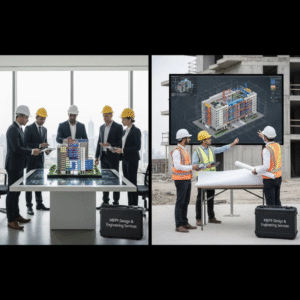
BIM is much more than “3D CAD on steroids.” It is a shared, data-rich digital model of your project that includes:
geometry and 3D layout
properties of materials and systems
performance parameters (U-values, efficiency, loads)
construction sequences and schedules
When MEPF systems are modelled inside the same BIM environment as the architectural and structural elements, and that model is linked to simulation tools, a project team can:
1. Simulate energy loads at concept stage
Early massing, orientation and envelope decisions drastically affect heating, cooling and daylighting. BIM-based simulations let the team compare options and choose the most efficient form – before a single brick is laid.
2. Optimise HVAC and distribution networks
Because ducts, pipes and cable trays are visible in 3D, engineers can:
shorten runs
reduce unnecessary bends
minimise pressure drops
This lowers both first cost and running cost, without trial-and-error on site.
3. Run lifecycle and embodied carbon assessments
With accurate quantities extracted directly from the model, it becomes easy to:
compare material options
estimate embodied carbon
calculate lifecycle cost for each scenario
This supports smarter decisions about concrete mixes, steel usage, finishing materials and more.
4. Detect clashes before construction
Clash detection in BIM flags conflicts between structure, architecture and MEPF early. Fixes are applied at the digital level, not the physical one, cutting down on rework and waste.
5. Create a digital twin for operations
After completion, the same model can be connected to real-time data from sensors and building management systems. This digital twin allows operators to:
visualize where energy is being wasted
detect faults quickly
plan predictive maintenance
Together, these capabilities transform a building from a static object into a continuously optimised asset.
The Infranox Global Solutions (IGS) approach
Infranox Global Solutions (IGS) combines sustainability strategy, BIM and MEPF expertise to deliver buildings that are efficient, resilient and financially sound. Our approach is end-to-end:
1. Strategic planning and performance targets
We begin by setting clear, measurable KPIs, such as:
kWh/m² per year (energy intensity)
litres per person per day (water intensity)
kgCO₂e/m² (embodied carbon)
thermal comfort and indoor air quality metrics
Targets are aligned with your business goals: LEED, IGBC or GRIHA certification, net-zero objectives, or aggressive lifecycle cost reduction.
2. Scan-to-BIM and asset digitisation for existing buildings
For retrofit projects, IGS uses LiDAR and other advanced surveying tools to create accurate as-built BIM models. This ensures we’re working with reality, not guesswork, when planning upgrades.
3. Early energy modelling and daylight analysis
Using the BIM model, our sustainability specialists run multiple “what-if” scenarios, testing:
envelope options
shading and glazing strategies
internal layouts
orientation and massing
Small design adjustments early can reduce loads dramatically and shape more efficient MEPF systems later.
4. MEPF optimisation and coordination
Our engineers design and coordinate:
HVAC systems
plumbing and drainage
electrical power and lighting
fire detection and suppression
All within a single BIM environment. Automated clash detection and routing optimisation reduce material use, accelerate construction and support future maintenance.
5. Lifecycle assessment and material strategy
Using quantity data from BIM, IGS evaluates embodied carbon and lifecycle cost for different material choices. We recommend low-carbon options, modular solutions and prefabrication where they make economic and environmental sense.
6. Renewables and microgrid design
We assess the feasibility of:
rooftop solar PV
energy storage
demand management strategies
By integrating these systems into BIM, we ensure structural capacity, shading and MEPF interfaces are correctly handled from the start.
7. Commissioning, digital twin and ongoing optimisation
Once the building is complete, IGS hands over not just drawings, but a combined BIM + BMS digital twin. This enables:
predictive maintenance
continuous commissioning
performance dashboards for owners and investors
Savings are tracked and verified, not just promised.
Deep dive: 7 powerful strategies for sustainable, efficient buildings
Strategy 1: Passive design and envelope optimisaton
Optimised orientation reduces unwanted solar gain.
Shading devices and properly chosen glazing balance daylight and heat.
High-performance insulation and careful detailing cut losses and gains.
These passive moves reduce the size and cost of active systems like chillers and boilers.
Strategy 2: Right-sized, smart HVAC systems
Oversized equipment is common and costly. BIM-based load analysis allows precise sizing, while:
variable speed drives (VFDs)
advanced building controls
zoning and scheduling
ensure that systems run only as much as they need to, when they need to.
Strategy 3: Efficient lighting and controls
LED lighting combined with:
occupancy sensors
daylight harvesting controls
smart scheduling
delivers quick payback and long-term savings. BIM helps coordinate luminaires with architecture and services to avoid conflicts.
Strategy 4: Distributed renewables and storage
Rooftop PV and battery storage can:
offset a large portion of energy consumption
reduce peak demand charges
support critical loads during outages
BIM is used to plan exact panel placement, tilt and access routes, ensuring performance and maintainability.
Strategy 5: Water efficiency and reuse
Water-smart buildings integrate:
rainwater harvesting
greywater treatment and reuse
low-flow fixtures
smart irrigation systems
These systems are coordinated in the MEPF model to avoid clashes and to optimise pump sizing and routing.
Strategy 6: Construction efficiency and low embodied carbon
Through detailed BIM models, IGS:
eliminates most clashes before site work
supports prefabrication for MEP modules
reduces material offcuts and site waste
The result: lower embodied emissions and smoother site execution.
Strategy 7: Continuous commissioning through a digital twin
A building is only truly sustainable if it stays efficient. Connecting the BIM model to live data allows IGS and your facility team to:
compare actual performance with design intent
identify anomalies and inefficiencies
refine control strategies over time
This is where digital technology turns Green Building from a “project” into a living system.
Why retrofits offer the fastest returns
In many cities, most of the buildings that will exist in 2040 are already standing today. That makes retrofit work a crucial part of the sustainability journey.
The IGS retrofit workflow
Rapid audit and scan-to-BIM
Baseline energy and water modelling
Prioritised intervention list (controls, HVAC, envelope, water, renewables)
Phased implementation so savings start early
Ongoing monitoring and optimisation via a digital twin
Typical paybacks
Lighting and controls: often under 2 years
HVAC upgrades and optimisation: usually 3–6 years
Solar PV: often 4–8 years depending on tariffs and incentives
Because these measures produce direct savings on operating budgets, they can often be funded through performance-based contracts or green financing.
Materials, embodied carbon and circular thinking
As grids get cleaner, embodied carbon becomes a larger share of total building emissions. IGS uses BIM to:
compare conventional and low-carbon materials
model hybrid structures (e.g., concrete + steel + timber)
plan for disassembly and reuse
By embedding circularity into design – not just operation – projects become more resilient and future-proof.
Certifications and labels: turning performance into market value
Labels such as LEED, IGBC, GRIHA and BREEAM provide credible proof of performance. BIM makes the path to certification smoother by:
documenting material use and construction processes
providing accurate simulation outputs
organizing all evidence in a consistent digital format
For owners, certification signals quality to tenants, investors and lenders, increasing asset attractiveness.
Illustrative results: what clients can realistically expect
Example A – Commercial office retrofit
12-storey building with old air-handling units and poor controls
IGS approach: scan-to-BIM, HVAC control retrofit, LED upgrade with sensors, rooftop solar, rainwater harvesting
Estimated outcomes:
~32% reduction in annual electricity use
~45% reduction in potable water consumption
ROI under 5 years on the combined package
Example B – Institutional campus transformation
Multi-building campus with mixed-age infrastructure
Interventions: passive shading, façade upgrades, central PV + battery microgrid, campus-wide BMS and digital twin
Estimated outcomes:
40–60% reduction in energy intensity across the campus
Significant improvement in comfort and reliability
Strong educational showcase for sustainability in action
These examples illustrate what can happen when sustainability, BIM and MEPF are aligned from strategy to operation.
Build a Greener World with INFRANOX GLOBAL SOLUTIONS
If you are planning a new project, upgrading an existing facility or simply trying to cut rising utility bills, Infranox Global Solutions (IGS) can help you move from generic sustainability talk to real, measurable performance.
Email: info@infranoxglobalsolutions.com
Phone: +91 7737498016
2 thoughts on “7 Powerful Green Building Strategies: BIM-Enabled MEPF Design for Net-Zero Performance | Infranox Global Solutions (IGS)”