


Introduction — building green starts before the first brick
Sustainable construction is no longer a marketing badge — it’s a business and regulatory necessity. Rising energy costs, scarce water resources, and stricter environmental compliance mean that poor early decisions compound into long-term costs, health problems, and missed value. Too many projects “add green” late in the process and then wonder why targets aren’t met. This guide expands the original checklist into a practical, problem-solving manual: for each precaution you’ll find why it matters, what goes wrong when you skip it, and concrete steps to implement it. This makes the document useful to developers, architects, MEP engineers, contractors and facility owners aiming for measurable outcomes in sustainable construction.
What is sustainable construction (brief)
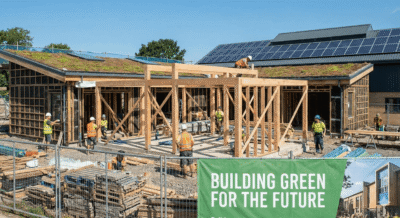
Sustainable construction is the integrated practice of planning, designing, building and operating built assets to minimize environmental impact, protect occupant health, and deliver durable economic returns. It combines passive design strategies, resource-efficient systems, low-impact materials, waste management, and performance verification across a building’s lifecycle.
Why this matters — the benefits and the cost of getting it wrong
When done right, sustainable construction reduces operational costs, improves indoor health and occupant productivity, increases asset value, and reduces climate-related risk. When handled poorly, “green” features add upfront expense without performance, certifications become marketing only, and retrofit costs escalate. The difference lies almost entirely in precautions taken before construction.
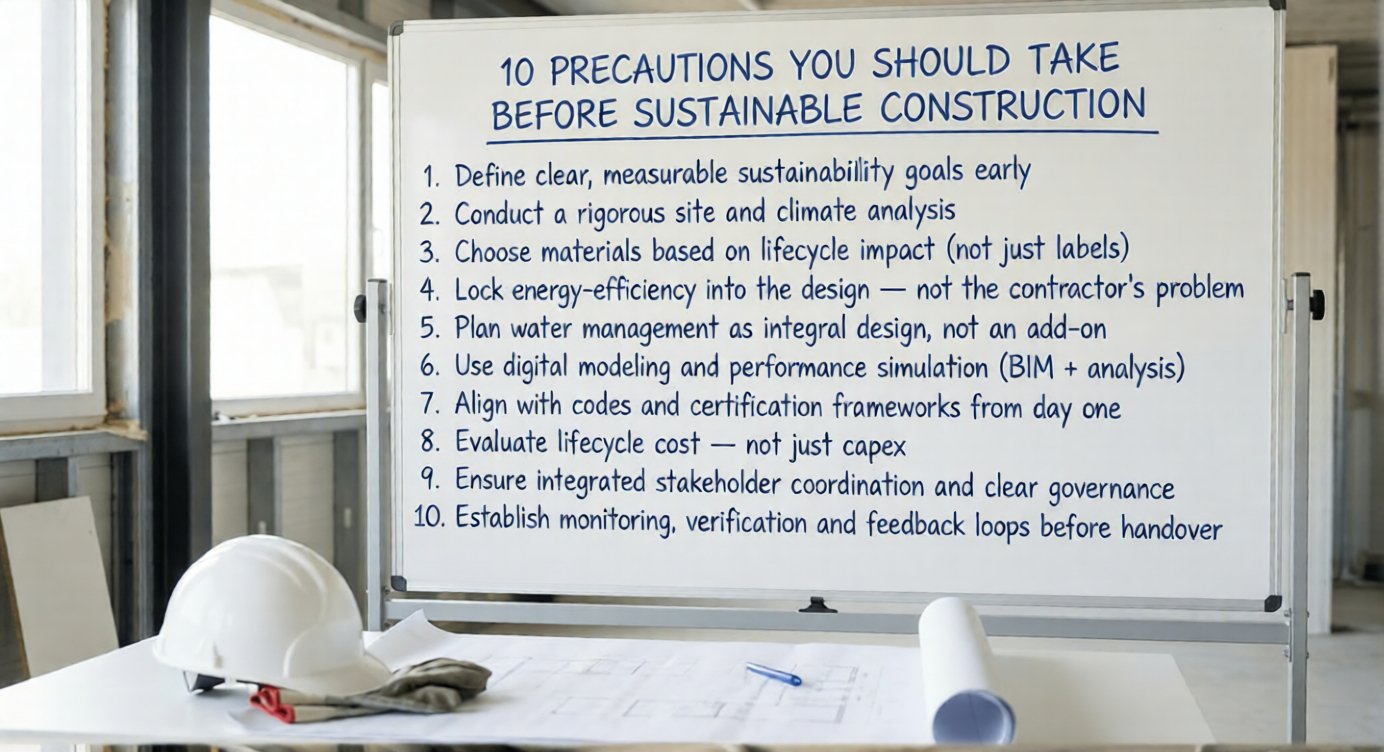
10 Key Precautions — problem-focused and actionable
1. Define clear, measurable sustainability goals early
Why it matters: Vague goals lead to inconsistent decisions: one team thinks “low energy,” another thinks “low cost.”
What typically goes wrong: Conflicting priorities cause scope creep — e.g., high-performance glazing selected without corresponding shading, increasing cooling loads.
How to implement:
-
Set SMART targets (e.g., EUI ≤ X kWh/m²/yr, potable water reduction ≥ 40%, embodied carbon reduction ≥ 20% vs baseline).
-
Decide certification ambition (if any) and list mandatory vs aspirational targets.
Quick checklist: documented targets, baseline metrics, sign-off by client and lead consultants.
2. Conduct a rigorous site and climate analysis
Why it matters: Climate and site characteristics determine passive strategies that reduce mechanical loads.
Problem when ignored: Buildings become dependent on mechanical systems for comfort and ventilation, increasing energy and operating costs.
Practical steps: mapping sun-path, wind corridors, microclimate, water runoff; identify existing vegetation to retain; test soil and groundwater. Use climate data to set orientation and shading designs.
Tools: climate analysis tools, sun-path diagrams, wind rose charts.
3. Choose materials based on lifecycle impact (not just labels)
Why it matters: Some low-cost or “green-labeled” products can have high embodied carbon or poor durability.
Common pitfalls: Choosing low-emission paints but heavy, carbon-intensive structural materials that negate gains.
How to implement:
-
Conduct embodied carbon assessments for major material choices.
-
Prioritise durable, low-maintenance, locally sourced materials.
-
Specify deconstruction-friendly assemblies to enable future reuse.
Checklist: LCA summary for key materials, local sourcing plan, maintenance and replacement schedules.
4. Lock energy-efficiency into the design — not the contractor’s problem
Why it matters: Energy behaviour is determined in early architectural and MEP decisions.
When ignored: Over-sized HVAC, thermal bridging, or excessive glazing cause high energy use and occupant discomfort.
Actionable steps:
-
Set envelope U-values and glazing performance targets.
-
Use daylighting and glare analysis to optimize glazing ratios.
-
Right-size HVAC based on modeled loads rather than rules-of-thumb.
Metric: Target Energy Use Intensity (EUI) and modelled consumption in kWh/m²/year.
5. Plan water management as integral design, not an add-on
Why it matters: Water scarcity and regulation make effective water planning essential for resilience.
Failures seen on sites: Rainwater harvesting tanks sized after construction; no greywater routing; overplanted landscapes.
How to implement: integrate rainwater harvesting, greywater reuse, efficient fixtures, xeriscaping and leak detection into early engineering drawings. Tie stormwater management to site grading plans.
Measurement: Litres/person/day benchmark, % rainwater reuse.
6. Use digital modeling and performance simulation (BIM + analysis)
Why it matters: Data-driven design identifies clashes and predicts performance before construction.
Common issue: Design intent lost in documentation handoffs; thermal performance differs from expectations.
Practical approach:
-
Adopt BIM for coordination and clash detection.
-
Run energy, daylight, thermal comfort and lifecycle cost simulations early and at key design milestones.
-
Iterate design with simulation feedback.
Benefit: Reduced rework, optimized systems and measurable performance forecasts.
7. Align with codes and certification frameworks from day one
Why it matters: Certification and compliance influence design choices and procurement. Tackling them late causes redesign and schedule delays.
Frequent problem: Teams learn of mandatory ECBC/green-rating requirements too late and must retrofit solutions.
Solution: Map applicable codes/ratings and assign compliance responsibilities. Track required documentation throughout design and construction.
8. Evaluate lifecycle cost — not just capex
Why it matters: Immediate savings on equipment or materials often translate into higher lifecycle costs.
Common miscalculation: Choosing the cheapest equipment with high operating and maintenance expenses.
How to implement: Run lifecycle cost analyses comparing capital cost, energy costs, maintenance, replacement cycles and residual value. Present these to financial decision-makers.
9. Ensure integrated stakeholder coordination and clear governance
Why it matters: Sustainable outcomes require aligned decisions across disciplines.
What breaks: Fragmented procurement, late subcontractor onboarding, poor coordination on interfaces like façade-MEP.
Practical fix: Use an Integrated Project Delivery (IPD) or at minimum a coordination plan with roles, BIM protocols, and regular sustainability checkpoints. Include operations team early for maintainability input.
10. Establish monitoring, verification and feedback loops before handover
Why it matters: Without measurement, targets remain aspirational.
Typical failure: Commissioning incomplete, no meter data, and performance drifts unchecked.
Implementation: Specify metering strategy, monitoring dashboards, performance acceptance tests, and a post-occupancy evaluation (POE) period. Set clear KPIs and responsibilities for data analysis and corrective actions.
Challenges, solutions and case examples (practical problem-solving)
Challenge: Perception of high upfront cost
Solution: Present lifecycle cost scenarios and payback timelines. Highlight soft benefits (tenant retention, premium rents, lower vacancy).
Challenge: Contractor resistance to new methods
Solution: Include sustainability requirements in procurement packages, offer training and early contractor involvement.
Challenge: Fragmented data management across stakeholders
Solution: Centralized BIM model, single-source-of-truth documentation, and regular model-based reviews.
Example (generic): A mid-rise office in a water-stressed Indian city reduced municipal water use by 55% by combining rooftop rainwater harvesting, greywater recycling, and native landscaping — a result only achievable because water strategy was embedded in site planning and landscape design.
Metrics and monitoring — what to track and why
To make sustainability verifiable, track these measurable indicators:
-
Energy Use Intensity (EUI) — total energy per m² per year.
-
Operational carbon and embodied carbon (tonnes CO₂e).
-
Potable water use per occupant (L/day).
-
Indoor Environmental Quality — CO₂ levels, VOCs, thermal comfort survey results.
-
Waste diversion rate during construction and operations.
-
Lifecycle cost and avoided operating expenses.
Set targets, monitor monthly for the first year, and conduct annual POE reviews.
Sustainable Construction forms the structure for a better tomorrowFrequently Asked Questions (expanded)
Q: How much extra does a sustainable building typically cost?
A: Incremental cost varies by ambition. Mild efficiency measures can add 1–5% capex but commonly pay back within 3–7 years through lower operating costs. Deeper net-zero ambitions can require higher initial investment but deliver stronger long-term returns and risk mitigation.
Q: Can existing building designs be adapted easily?
A: Retrofitting is possible but typically more expensive than integrating sustainability during design. Focus first on envelope improvements, systems optimization, and controls before more invasive interventions.
Q: Which certifications are most relevant in India?
A: National and international frameworks exist; choose based on project goals and market expectations (energy code compliance should be non-negotiable).
Q: Who should be responsible for post-occupancy performance?
A: The owner or facility manager should own ongoing performance, but commissioning agents and the design team must provide robust handover documentation and training.
Sustainable Building Materials: perfect Innovations for Eco-Friendly Construction-2025Sustainable Construction Blog
Sustainable Construction — A Practical Guide for Decision-Makers-2025Contact Us at:- Info@infranoxglobalsolutions.com